TEN Skincare Review - A new skincare range for mother & baby

Posted on

I’m sure you’re already aware I’m skincare obsessed. So much so, Craig and I have our own bathrooms so he won’t lose his shaving foam under all my lotions, serums and body butters. I’ve passed this obsession down to my children and now Dexter’s favourite post-bath ritual is to smother himself in E45.

Whilst I adore all the massages and slippery cuddles with the kids, I often neglect my own skincare routine. There are days I’m so exhausted I’ll fall asleep next to Craig with a full face of make-up, and gone are the days I have baby soft legs against our bedsheets every night.

As such, I love products that are specifically designed for the dehydrated and tired skin of a new mum. Making the transition from breastfeeding to formula, late nights, and an erratic diet can play havoc with your skin. With Heidi only 16 weeks old, I can definitely testify to this. Most notably, my boobs have lost some of the elasticity they once had. Okay, compared to some, I’ve got off lightly. They’re not yet drooping and are still firm enough to look good in a bikini, but there are some stretchmarks at the top of my chest where gravity and rapid growth are taking their toll.

So for the last few weeks, I’ve been trialling Clever Skin’s new -TEN- Skincare Breast Care Cream. This has been specifically formulated to combat stretchmarks, improve elasticity and firm up the breasts during pregnancy and beyond. Their no nonsense brand message promises to use skin science that is as natural as possible and will offer the very best results.

At -TEN-™ we have a no-nonsense approach to skincare and empower you with making the right skincare choice for you. We tell you what the key ingredients we use are, and most importantly, why these are used.

My hope was that the weakened skin around the top of my breasts would receive some much-needed nourishment. Fluctuating growth throughout pregnancy and nursing, then switching back to the bottle quickly, saw them grow to a staggering 34HH from a 36G so the skin has certainly been stretched. I just wanted a smoother appearance and a bit more firmness to counteract even more stretchmarks as I attempt to lose the baby weight.

So what’s in it?

Rice extracts (Oryza sativa) - Rich in anti-oxidants and essential fatty acids which are an effective substitute for lanolin, this can help reduce inflammation and itching. It is also a great source of vitamin E which helps to protect dry, scaling and chapping of skin.

Papaya extracts - Elastin and collagen are two fibers in the skin that contribute to skin firmness and help restore skin elasticity. The papain (a digestive enzyme) in the papaya can help rebuild the elastin and therefore help improve the elasticity and firmness of your skin.

Hydrolyzed fibronectin - Proteins are made of long chains links made of amino acids. So for instance, collagen has about 1,000 such links. Fibronectin (also a protein) has a molecular weight of 4,000 amino acids. Fibronectin is a large molecule in fact too large to be absorbed by the skin, and so it is reduced by being hydrolized, thus making it easily absorbed. It is added to improve overall elasticity and skin firmness.

Whoa!

I know what you’re thinking! Didn’t -TEN- say they were going to leave out all the science jargon for the benefit of us mere mortals…? They definitely could dumb it down further. However, the proof is in the pudding so to speak.

To my surprise, the cream has made a notable difference to my boobs. This might just be because they’re now receiving more attention than before and getting a daily massage. Regular massage can help improve your circulation and encourage new tissue growth so it wouldn’t be unusual to see visible results if the skin is getting a bit more love than usual. But all in all, I’m really happy with the results.

I’d described the smell as a mixture of sun lotion and cocoa butter that isn’t at all unpleasant. Give it 3 minutes to sink in and it dries to a matt finish. I’ve also been using this on my hands and have noticed they look much younger. At £34.50 (inc tax) this is undeniably expensive compared to high street alternatives, but I just can’t argue with how great my skin looks.

I also trialed the Hydration Body Cream which has an exhaustive list of ingredients including Vitamin B5, Vitamin E, Vitamin F, Camellia Oleifera Seed Oil, Avocado Oil, Cacao Butter and Wheat Germ Oil. There’s an explanation on the website behind each ingredient that is just as mind-boggling as the breast cream, but once again this stuff really works.

The smell is equally good, it’s incredibly hydrating and leaves your skin silky smooth. It’s also really cooling and refreshing and would be a real treat for swollen tummies & legs during pregnancy, particularly as the skin can undergo some fairly dramatic changes due to hormonal activity within the body. At £31.80 (inc tax), once again it’ll be one of the more expensive brands available to you, but you do get a soft sheen that lasts the entire day.

My only criticism of the range (and this is perhaps a little unfair) is that the Clever Skin website clearly needs some proof-reading. I spotted several spelling mistakes that might ultimately put people off what is essentially a premium product. Other than that, the rest of the range looks to be equally impressive with products tailored to expectant mummies, babies, and the everyday woman, with face, body and hair all covered.

Okay, the range isn’t cheap, but it’s a lovely range for mama & baby pampering. It’s lightly scented and incredibly delicate for sensitive baby skin, and skin that’s undergoing the trauma of pregnancy. It would make a fabulous gift for new and expecting mums, or an ideal treat for yourself if you’re feeling a little jaded with your post-baby body. If you’re into skincare, or have a specific skin complaint that’s affecting your comfort or confidence, you won’t be disappointed by -TEN-.

You can buy the range from CleverSkinCare.com or from Boots. You can also see what other mums thought of the range by checking out TENSkincare on Facebook and Twitter.

Samples were provided for this TEN Skincare Review
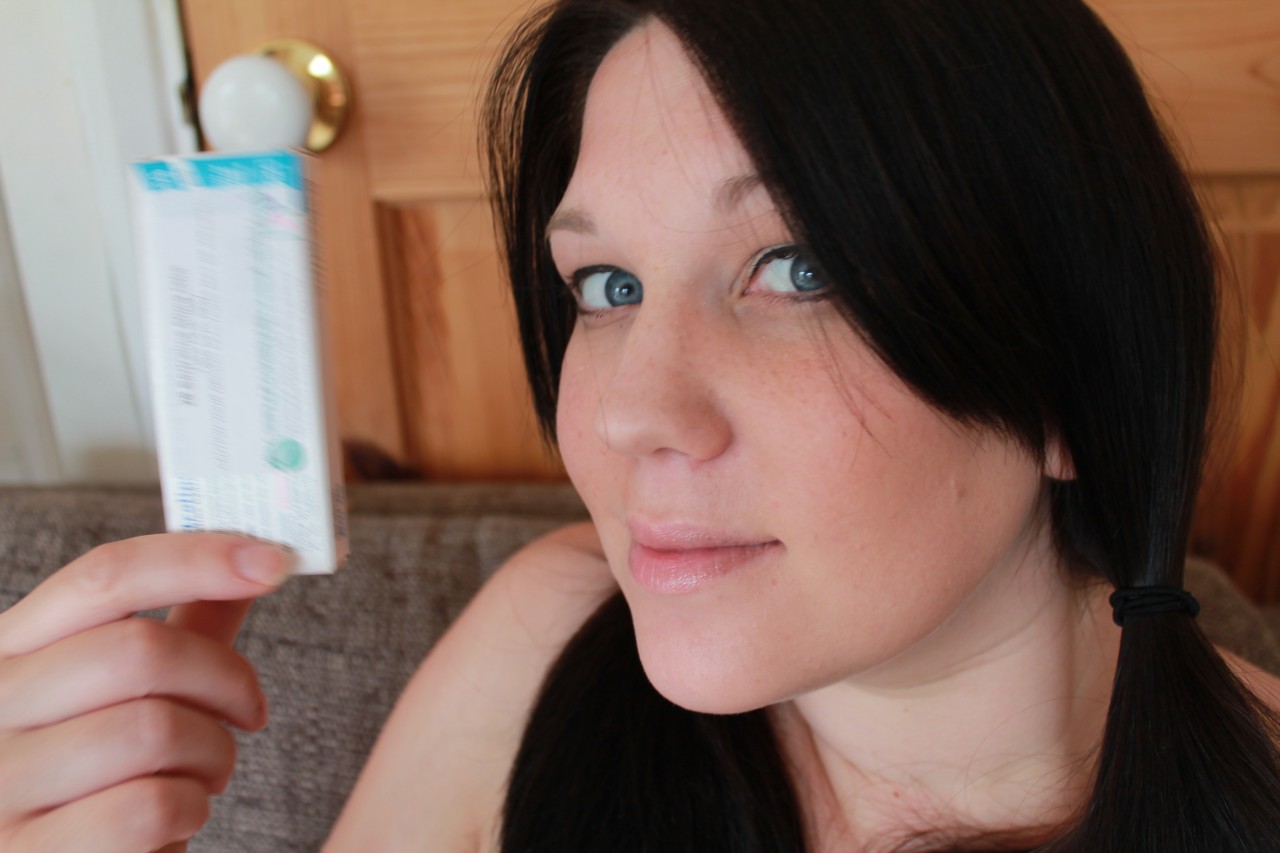


Sex after childbirth: is the pill still safe for breastfeeding mums?

Posted on

Becoming a mother is an exciting time, and how women feel after giving birth varies greatly from person to person. Whereas some women will be eager to continue their sex lives right away, others will feel as though they need some much deserved ‘me-time’ and wait a while before having intercourse. Both responses are perfectly natural.

One thing’s for certain, after giving birth, having another child is unlikely to be on the agenda straight away. Using the right contraceptive can allow you to carry on enjoying your sex life when you feel ready, whilst providing effective protection against pregnancy.

It is natural for new mums to worry about how their birth control methods will affect their infants, particularly when breastfeeding. Whilst many women start to use contraception again shortly after childbirth, there are some methods that are more suitable than others for nursing mothers. Being aware of the dos and don’ts can give you complete peace of mind that both you and your baby are safe, happy and healthy. After all, you’ll have enough on your plate without feeling stressed about contraception!

069

When is it safe to start taking my pill?

In short, you should not start taking your pill until 21 days after giving birth. However, it is usually recommended that you abstain from intercourse for the first few weeks until you have had a postnatal checkup to ensure that your body has properly healed and that you have no medical conditions that make you incompatible with the pill.

Women can be fertile again within a few weeks of having a baby, so it is a good idea to start thinking about taking your contraception as soon as possible, even if you don’t plan on having sex for a few weeks. Although many women will not start their periods until after they have finished breastfeeding, it is still possible to ovulate, and using the contraceptive pill from the outset can provide complete reassurance.

Combined pill

The combined pill contains both oestrogen and progestogen and has a tendency to reduce the production of milk in breastfeeding mothers. Because this pill has the potential to interfere with the milk supply, it is not recommended for use during breastfeeding or for up to six months after the birth.

Progestogen-only pill

Progestogen-only pills, also known as mini-pills, do not interfere with lactation and are therefore safe to use during breastfeeding. Although it is possible for a small amount of progestogen to pass through into your breast milk, this will not cause any harm to your infant or have any adverse health effects on weight or development.

Progestogen only pills such as Cerazette are an extremely effective birth control method, but will need to be taken at the same time everyday.

Other considerations

It is worth noting that the pill you used before pregnancy may not be the right choice after giving birth, especially if you are breastfeeding. Talking to your GP or another healthcare professional can help you weigh up the different options and decide on a birth control method that is compatible with both you and your baby. Other safe and effective birth control methods for breastfeeding mums include the injection, the implant, an intrauterine device (the coil) or condoms.

In association with Cerazette


GIVEAWAY: Share your thoughts on Breastfeeding & win a £50 Amazon Voucher

Posted on

8627118BreasfeedingLargeSOURCE: SafeHealthyChildren.org

I was recently contacted by Benenden (personal health care experts) about a survey they’ve undertaken to coincide with this week’s World Breastfeeding Week. The aim was to unpack some of the concerns women have about breastfeeding in public, and to try and dig a little deeper as to other people’s views, both for and against. It certainly makes for interesting reading.

By surveying men and women from a range of age groups and ethnicities, the hope was to not just find out just how much of the population doesn’t agree with breastfeeding in public, but why this is and whether these opinions are impacting on a mother’s decision to breastfeed. While many people don’t see a problem with it, many others find it quite off-putting and even offensive – but why? Is it down to personal views or even a deeper reason, such as faith?

Picture-10SOURCE: The Metro, 2011

The results!

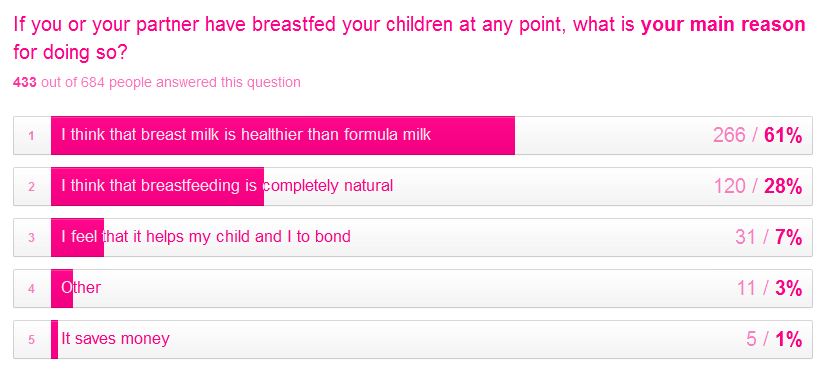
Encouragingly, the survey reveals that 84% of those surveyed either breastfed, or supported their partner in doing so. The pro-breastfeeding message is clearly getting through as the majority of those answering affirmatively cite their reason for choosing breast milk is that it’s healthier than formula.

Breastfeeding

My views on this might be considered controversial, but bear with me.

Although it would be silly of me to argue with science (I know that breast milk is indeed more nutritious for baby), I have a real problem with the constant pressure from midwives, and have questioned their insistence on it fairly audibly on this blog. I felt very much as though the NHS strong-armed me into breastfeeding from the get-go with both of my children. Midwives never missed an opportunity to sell breastfeeding in antenatal classes, and I felt incredibly pressurised to whip out my boobs when recovering from my c-section with Dexter. This, despite the fact I was completely overwhelmed and sore from surgery.

Whilst I wholly support women who choose to breastfeed (I lasted 6 weeks with both of my children), I just wish healthcare professionals would be more supportive of those who choose not to do so. Indeed, there are some circumstances where breastfeeding is not possible, or even damaging to a woman’s mental health. I certainly felt there was a link between my own PND and breastfeeding.

Breastfeeding1

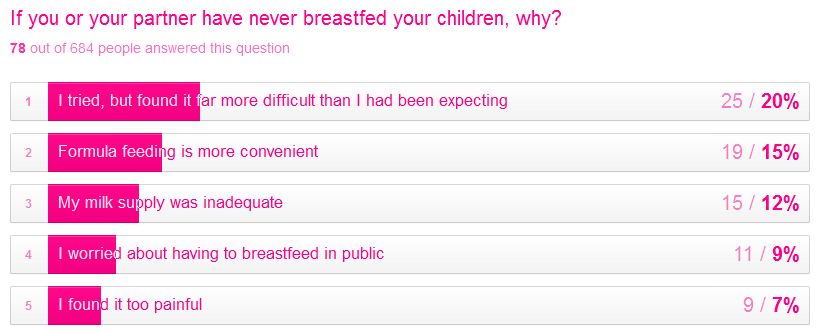
Less than 10% of those who abandoned breastfeeding, or didn’t attempt it, cite emotive reasons such as feeling uncomfortable with it. Instead, the reasons given are largely practical such as pain or low milk supply. Sadly, lack of supply is actually a myth. Every woman has the capacity to breastfeed, and every woman who persists with it will have an adequate supply to sate baby. Similarly, pain is most likely a product of poor technique and could be nipped in the bud quickly by a lactation consultant. If you’re currently struggling and need a little support, I recommend the book Breastfeeding Made Easy by Carlos González which is great for debunking a variety of myths surrounding breastfeeding.

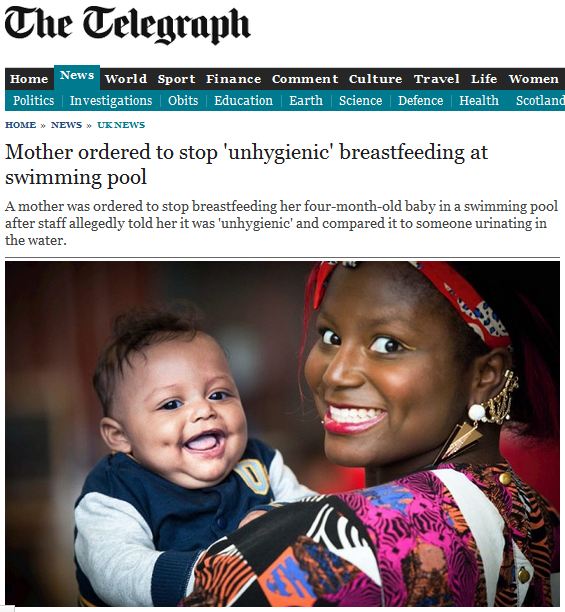
As regards the contentious issue of breastfeeding in public, the news is a little disheartening. I breastfed in public with Dexter just once, in a Macdonald’s carpark. I left the restaurant as I felt that I was putting people off their food, and forcing mums to confront a barrage of uncomfortable questions from their curious children. Needless to say my breastfeeding days with Dexter were numbered after this. It seems I’m not alone either.

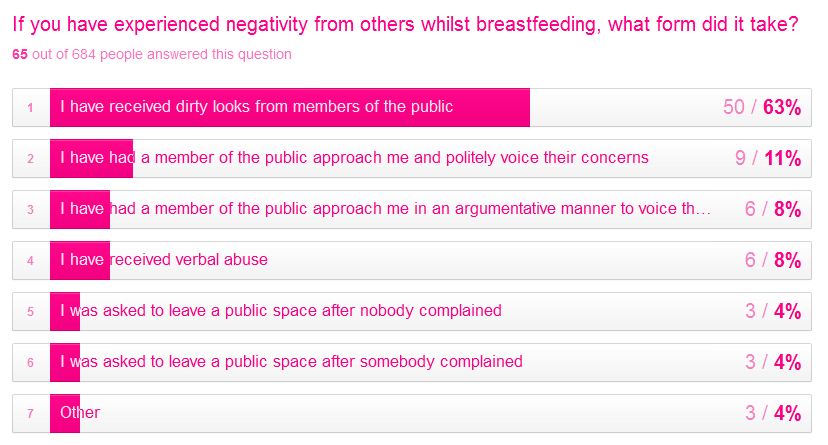
Negativity surrounding BF

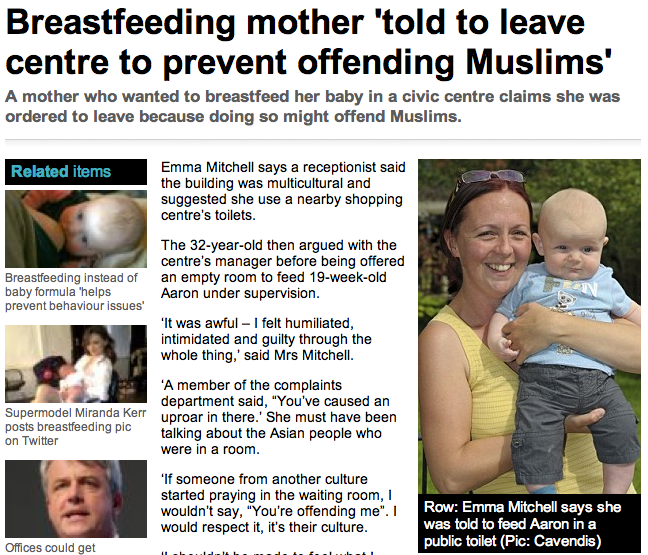
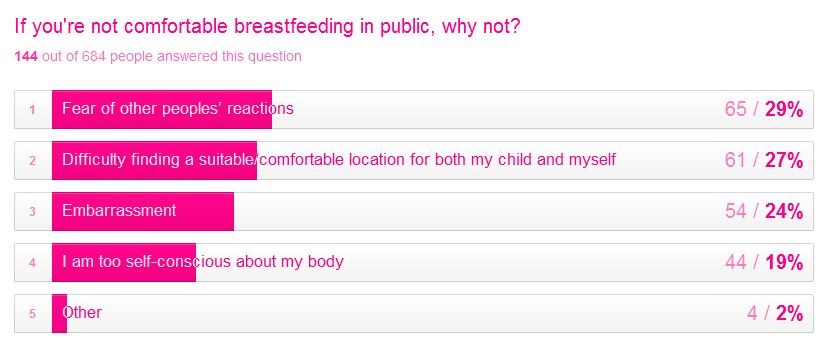
I certainly have some sympathy with the 27% who cite that they abandoned breastfeeding as they’ve had difficulties getting themselves and baby into a comfy position. I struggled enormously with this due to my 34HH boobs. More worrying, however is the perceived negativity and hostility from onlookers. The press have certainly done a job on us all and are incredibly quick to print stories of nursing mums being kicked out of public spaces.

Capture2

But it seems some of this paranoia is unfounded. Despite the fact that almost half of those surveyed had not attempted to breastfeed in public, perhaps more importantly only 20% of those that do embrace out-and-about feeds have experienced negativity from others. 20% is still too high in my opinion, but it’s certainly better than I expected.

bf

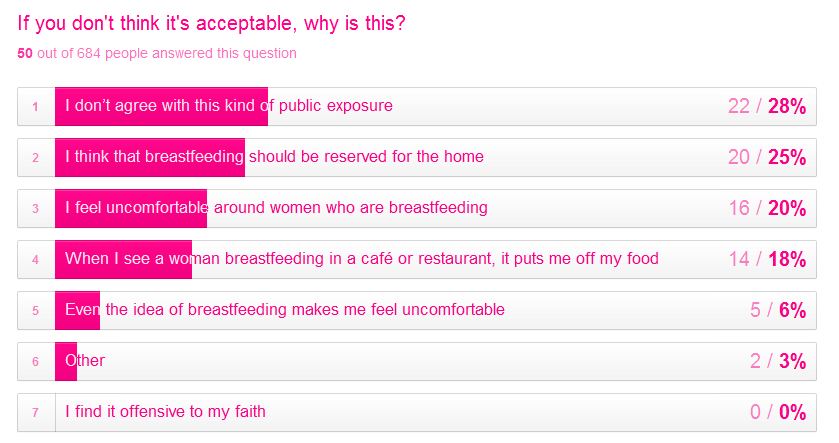
Perhaps the most interesting response of all however is the feedback from those brave enough to voice their personal reasons for not appreciating breastfeeding in public (12% of people surveyed). Thankfully faith was cited by only a negligible number of people, and most went onto say they would be more supportive if a woman wore a cover-up.

bf2

Far from being upset by this, I find it refreshing. I actually share a few of these concerns myself as I felt so concerned about other people’s feelings when I was breastfeeding my children. Even at home I would retreat to the bedroom if we had guests.

Was I too prudish? Unnecessarily concerned? I don’t know. But I do try to the respect the choices of everyone, and mine was to breastfeed alone, at home.

*** WIN a £50 Amazon voucher courtesy of Benenden ***

newlogo

In order to keep the debating going, Benenden are offering one lucky reader the chance to win £50 worth of Amazon vouchers. All you have to do to be in with a chance of winning, is share your experience of breastfeeding by leaving me a comment. If you’re yet to join the wonderful world of parenting you can just say what you think about the survey (HERE), or show your support (or indeed, lack of) for women who choose to breastfeed in public.

To make it fair, the winner will be picked completely at random by Rafflecopter.

Good luck guys!

a Rafflecopter giveaway


T&C’s – a.k.a – the boring bit!
  • Only 1 option is mandatory (leave me a comment) – the rest only improve your chances of winning so just complete as many as you feel like
  • UK entrants only – you must be over 18 too (sorry)
  • The winner will be contacted by email and must respond within 1 week of having been emailed (I’ll try all known avenues to contact them) or a new winner will be drawn
  • When the giveaway is closed, Rafflecopter will select the winner completely at random
  • The winners name will be published on this site

Win competitions at ThePrizeFinder.com

Related Posts Plugin for WordPress, Blogger...