

Last week the news was full of sound bytes from the Labour and Tory conferences. Ed’s controversial 20 month price freeze on energy prices has already been torn apart, but Cameron’s Help to Buy Scheme has largely avoided the same interrogation. Is this because it is hard to argue with? Or is because the wider implications of the scheme are little understood? I’ve played devil’s advocate and had a think about just what this could mean for the economy and household debt. Is this the ultimate example of clever politics, but stupid economics?
What is it?
In its crudest sense, it’s an attempt to make mortgages more affordable. Right now thousands of people are frustrated by the fact that they could comfortably afford mortgage repayments, but are struggling to raise the high deposit necessary to secure a mortgage in the first place. This scheme is an attempt to address this imbalance - potential homeowners now need only raise 5% deposit and lenders will come up with the other 95%.
So what’s so bad about that?
Well on the face of it, not much! As the proportion of UK homeowners is the lowest for some time under the Tory leadership, Cameron’s policy slots nicely into his Aspiration Britain theme and his much harped on about desire to help those who want to “Work hard and get on”.
As more banks catch up with the schemes early implementation, we should see more 95% mortgages offered, and more Britons getting that first precious foot on the elusive housing ladder. As homeowning is a much ingrained part of the British psyche (not least supported by the ongoing success of television favourites such as Location, Location, Location & Grand Designs) we’re likely to see many more of us achieving the dream. Right now the average age of a first-time buyer is (rather optimistically in my opinion) 30, with second-time buyers averaging at 39 - as historically mortgage lending was a far freer economy with flexible plans, 100% mortgages available, and greater freedom of movement up the ladder, the scheme is likely to be a popular one and considered long overdue.

SOURCE - The Telegraph
For current homeowners, the news couldn’t be better. With the relaxation in mortgage lending, house prices should begin to rise. They can sit pretty in the knowledge that the value of their homes should rise before their eyes with no expensive improvements necessary. It’s rumored that (proportionately) this rise should equate to more on a weekly basis than they typically earn per week at work. Lucky them!
The wider economy is likely to feel a little boost, and the scheme should stimulate the building industry. This should be welcome news (even if only short-lived) as the need for more houses is a constant hum in the ears of any would-be government.
So it’s all good then?
Not so fast.
Inevitably the interest rate you will have to pay on a 95% mortgage will be considerably higher than if you were able to offer a bigger deposit. Over the term of the loan you will therefore end up paying substantially more than those who had a little more upfront. This leads us nicely into the biggest risk of all - if we see a real increase in mortgages at 95% of a lightly inflated value (remember I mentioned house prices would rise) then all you would need is a slight increase in interest rates and a dip in house prices, and you could find yourself in negative equity with a huge debt you cannot service.
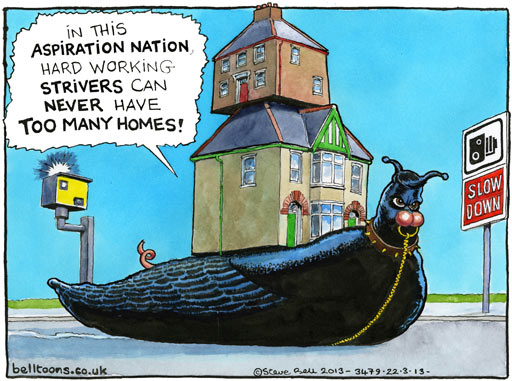
SOURCE: Steve Bell for The Guardian
This might sound like a worthwhile risk to you. Afterall if you plan to hold onto your new asset for a considerable length of time, you might decide you can ride out this climate of economic uncertainty and cash in / trade upwards when the time is right. But in reality, we just cannot predict what is around the corner. In an age of low job security, coupled with wildly fluctuating interest rates, your investment could well become a noose around your neck. Some have gone so far as to argue that the Help to Buy Scheme’s legacy will be little more than artificially engineered economic growth offset by increased household debt.
Remember the old addage “If something looks too good to be true, it often is”? Well this could well apply in this instance. For the government, the risk is fairly low. They will act as a virtual guarantor for your loan - a kind of insurance for banks & building societies if you will. The only cost to them will be if you default on a loan. In this instance, they will have to cover the shortfall. The cost of this however will be largely born by the homeowner themselves as they will be paying a greater proportion of interest over the term of their loan.
It’s also worth bearing in mind that if house prices rise, then houses themselves become less affordable. Although the scheme will benefit many, others will find themselves priced out of the market and even further from the realisation of owning their own home than before! It could even be argued that Cameron is further fuelling the class gap by widening that between the lower and middle class.
And whilst the focus is on lending to housing, industry is left on the back-burner. With SME’s begging for greater flexibility in lending, once again they’re left in the cold. It smacks of an attempt to crowd-please without addressing the need to nurture business and grow the economy from within. Although Cameron and his boys will refer me to the handful of concessions made to small businesses as outlined by their manifesto, these in no way stack up to what’s on offer to the general public on this occasion.
So am I just slamming the entire policy?
Not at all. I just question the economics.
For those desperate to own their own home, this could well be the best opportunity yet. If you are keen, I’d move double quick to take advantage before house prices see your dream home fall out of reach. I’d also be prepared to stay in for the long haul and expect yourself to fall in and out of negative equity for a few years to come. In a few years time, you also may well have to accept that a better deal may have been available if you’d hung on for just a little longer for the economy to further recover.
Furthermore in an age of low job security, renting shouldn’t be considered a bad option. Although we’ve all heard it criticised as effectively “throwing money down the drain” - this isn’t necessarily the case in today’s uncertain economy. We’re no longer a society that stays in the same organisation (or even career) for 20 years. This makes financial planning a potential minefield. There are also a wealth of hidden costs associated with owning your own home that a renter won’t have to consider. If you can stay renting, yet put aside even the smallest amount into a high interest savings account for a few more years, it might well be worth growing a healthy deposit before rushing into the Help to Buy Scheme.
